Tag Archives: ArcGIS Online

A Living Atlas of the World

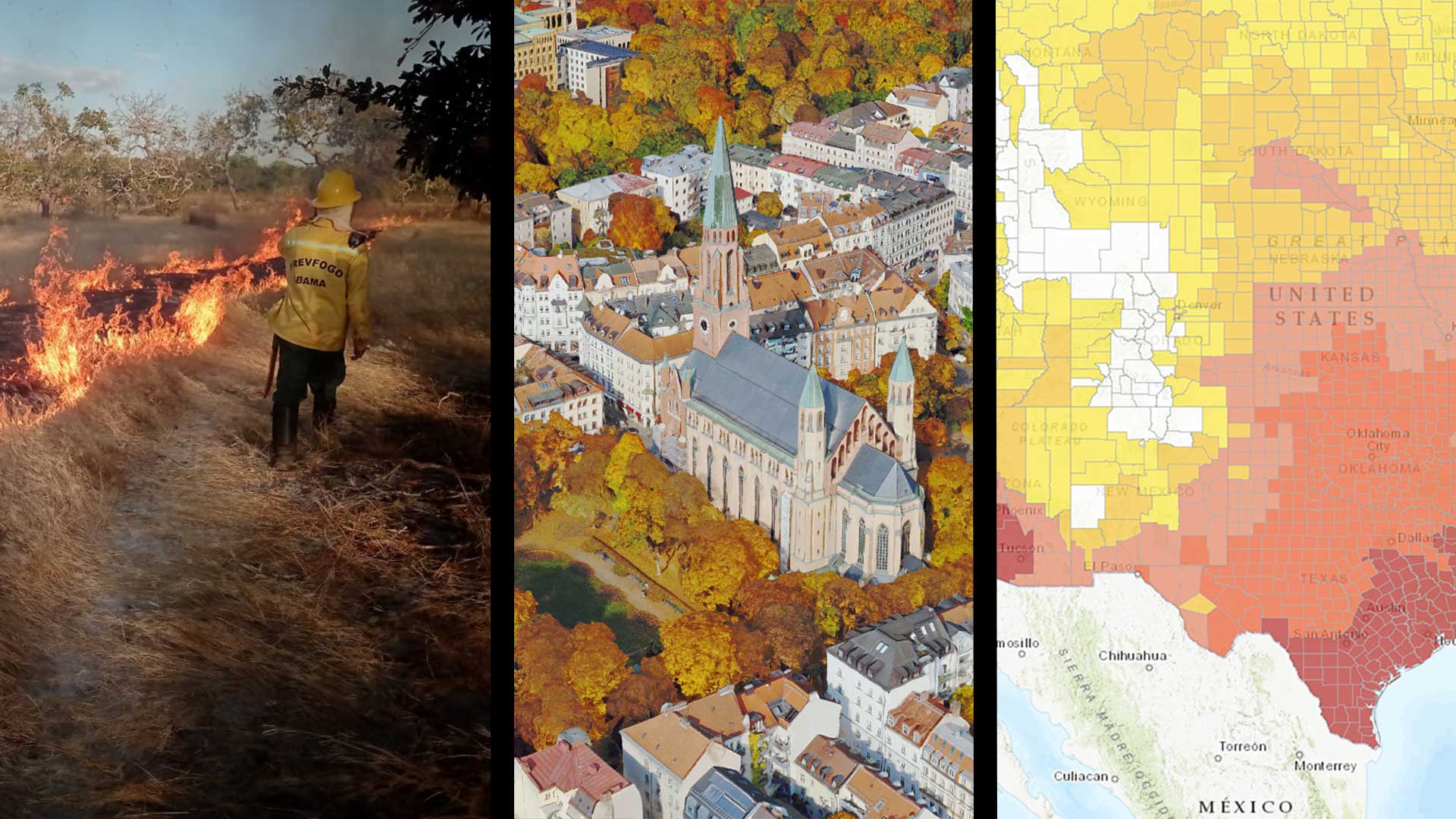
Atlases have long been used by people to help navigate and understand our world.  A traditional atlas consists of a collection of static maps portraying various aspects of geography, bound together in book form and updated with new information at long intervals.  The geography covered, in terms of both themes and extent, is set in stone for any given atlas, and the thematic information is typically created and authored by a select few authoritative sources.

These traditional atlases have served us well for many hundreds of years.  But today, the world is changing rapidly, and it’s difficult for traditional atlases to keep up with the pace of that change.  To help us keep pace with our evolving planet, our concept of what exactly constitutes an atlas must also evolve. Continue reading

Posted in Vision | Tagged , , , , , , | Leave a comment

Transforming ArcGIS into a Platform

At the foundation of Esri’s work are the belief and vision that geography is a science that creates a better understanding of our world. Using GIS, geography has also become a unifying framework for integrating many forms of digital information. GIS has now become an important technology in almost every field, improving efficiency, communication, and decision making. Our users have made GIS come alive in countless applications across thousands of organizations. I would like to both acknowledge and thank our users and partners for supporting Esri’s mission of evolving our GIS technology.


Historical Context

Over the last four decades, Esri has evolved both its business model and technology offerings through four distinct phases always focused on GIS software services and support.

Continue reading

Posted in Vision | Tagged , , , , , , | 1 Comment

Enabling the Fifth Part of a Successful GIS

Years ago when introducing GIS, we often talked about the five essential parts that make for a successful implementation–hardware, software, data, methods (or procedures), and people. These same five parts are still valid today, though their context has evolved considerably over time.

Hardware, software, data, and methods are challenges that we can manage in straightforward ways. We can understand what needs to be done, and we can identify the solution.

The latter ingredient–people–is the most complex factor. It’s the wildcard of GIS, and is also the primary key to successfully lifting a GIS off the ground, nurturing its growth, and (perhaps more importantly) keeping it relevant over time.

Continue reading

Posted in Technology | Tagged , | 1 Comment

Geography as a Platform

Following are a few notes from my talk at the 2012 Esri User Conference. You can watch the complete video here.

Geography is our platform for understanding the world.  GIS is making geography come alive. GIS condenses down all of our data, our information, our knowledge, and our science into a kind of language that we can easily understand: maps.

Maps help us integrate and apply our knowledge. Maps also tell stories—stories about almost everything in our world. We need to harness the power of maps to design the future and create better outcomes.

I’m very confident that we can do this. One reason is that GIS itself is advancing; it’s getting more powerful and it’s getting easier to use. It’s evolving with lots of new capabilities. It’s moving to the cloud and becoming more pervasive. GIS has evolved mapping to a new level, creating geography as a platform.

Continue reading

Posted in Vision | Tagged , , , , | Leave a comment

Private Clouds: Moving from Hype to Reality (Really!)

Back in 2008, the term “cloud computing” was barely a glint in the eye of most technology companies.  Perhaps they used SalesForce.com and Gmail, but tossing around the “cloud” terminology wasn’t really de rigueur.

Now it’s hard to imagine tech discussions without some reference to it at least once in conversation.  Seems like it’s everywhere – or at least the terminology is.

In 2009, Esri hitched its geo-wagon to Amazon Web Services (AWS) as our primary cloud provider.  But the general consumer audience was much more familiar with shopping experiences through Amazon.com rather than cloud hosted services off of AWS.  Fast forward less than three years, and things certainly have changed.  AWS has established itself as separate and different from Amazon.com, with a brand synonymous with “cloud” as a globally-known public cloud infrastructure service provider.   And in 2010, Esri announced the availability of ArcGIS Online, initially supported by AWS infrastructure under-the-hood, to bring the ubiquity of a public cloud platform to the geospatial community.

Continue reading

Posted in Technology | Tagged , , , , , , , , , | 6 Comments

Telling Stories with Maps

Stories are a very important aspect of our society, and storytelling is one of the things that make us uniquely human.  Stories convey important knowledge about the world around us, often in a simplified yet dramatic fashion designed for maximum impact.  We have much to learn, remember, and understand in life, but wrap a great story around something and it will make an impression on us that lasts a lifetime.

So where do maps fit in the storytelling realm?  I recently spoke with Allen Carroll, who left National Geographic about a year ago and is now ArcGIS Online Content Program Manager at Esri, about Story Maps—a new initiative he’s working on with David Asbury, Lee Bock, and Stephen Sylvia to integrate storytelling and maps.

Continue reading

Posted in Storytelling with Maps | Tagged , , , , , | 4 Comments

GIS for Everyone, by Anyone

Earlier this week I was meeting with one of the directors of a large state agency. Among other topics we discussed, he told me that his organization was adopting a policy to move away from custom application development. Whenever possible they would serve internal and public needs with off-the-shelf applications, or better yet, with those that can be easily custom-configured without the need for programming.

When asked why, he explained the last custom application they’d deployed had to be abandoned – the programmer had left for another job, had taken knowledge of its internal workings with him, and they were unable to hire (because of budget constraints) the programming expertise needed to make the necessary updates to the application.

Continue reading

Posted in Uncategorized | Tagged , , , , , , , , | 2 Comments

The Future of Cloud-based GIS Analysis with ArcGIS Online

The cloud is growing in importance for GIS professionals, with cost efficiency, scalability, and flexibility as major drivers. We can see the beginnings of cloud options for many organizations with the ability to run ArcGIS Server in the cloud and also via Esri’s managed services in the cloud.

On a similar, but yet somewhat different and exciting frontier, ArcGIS Online is a key part of the Esri vision for ArcGIS in the cloud. However, up until recently the focus for ArcGIS Online has been on the data part of GIS – making and sharing maps, apps, and other resources, and organizing online communities.

Continue reading

Posted in Uncategorized | Tagged , , , , , | 5 Comments

Inside New ArcGIS Online Basemaps

Basemaps are the canvas upon which you paint your data, the foundation that helps you create a map quickly and easily. But unlike the blank canvas an artist might use, ArcGIS Online basemaps also provide context and information that brings your data to life.

ArcGIS Online offers a large selection of ready-to-use hosted basemaps including the Esri World Imagery, Streets and Topographic basemaps, OpenStreetMap, Bing Road, Aerial, and Hybrid basemaps, and specialty basemaps that are designed to automatically sandwich your data between terrain and labels. These can be found and used from the basemap gallery that’s built-in to the ready-to-use ArcGIS Online applications, ArcGIS Desktop, and also the configurable ArcGIS for Flex and ArcGIS for Silverlight applications. The same basemaps are also available to developers via various APIs.

Continue reading

Posted in Uncategorized | Tagged , , | 1 Comment

Inside Intelligent Web Maps

Lately the words intelligent web maps have been used widely, and during the Esri 2011 International User Conference opening plenary session intelligent web maps were highlighted by Jack Dangermond and demonstrated throughout the day. So what makes for an intelligent map?

At the highest level the idea of intelligent maps is based on the fact that maps are fundamental to understanding our world, doing our work, and solving problems. They’ve evolved from simple paper maps to web maps that can be easily created, shared, and used in many different ways. And they’ve also grown in their ability to encapsulate and present geographic knowledge and capabilities, and deliver that to anyone, not just GIS experts.

Continue reading

Posted in Uncategorized | Tagged , , | Leave a comment