Tag Archives: Layer

An alternative to overlaying layer tints on hillshades

By Rajinder Nagi, Esri Cartographic Product Engineer

Overlaying rasters - thumbnail

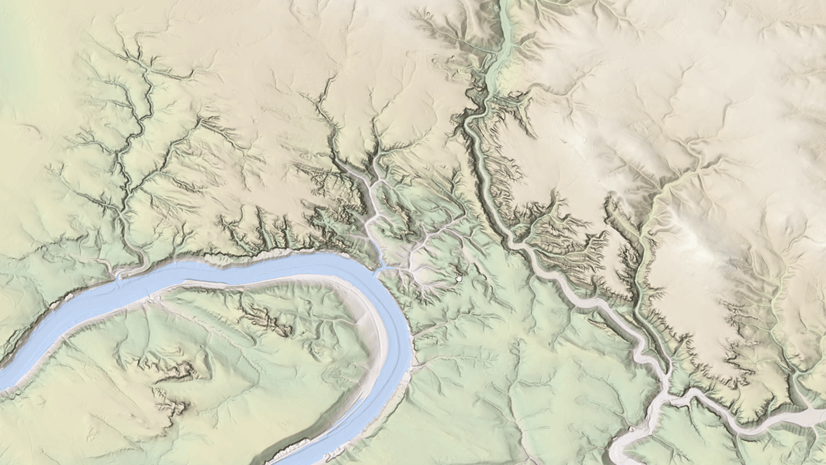
A common cartographic technique is to transparently overlay a colored raster, called a layer tint, over a grayscale raster, like a hillshade or a panchromatic aerial or satellite image. When you display a colored raster transparently over a grayscale raster, you lose the intensity of your colors and that it is harder to see the hillshade details. Continue reading

Posted in Imagery, Mapping | Tagged , , , , | 36 Comments

Save, Share and Quickly Apply Map Settings

When it comes to map production one of the most common challenges is to manage all of your organization’s mapping standards. Esri Production Mapping’s views helps address this challenge. With views you’re able to save your data frame and layer properties to the geodatabase and apply them at any time in ArcMap. This ensures production staff are utilizing the latest and greatest map settings defined by your organization, and promotes standardization and consistency across your map products.

Continue reading

Posted in Uncategorized | Tagged , , , , , , , , , , , , | Leave a comment

Changes to ArcGIS Desktop basemaps

The National Geographic basemap has now been added to the File > Add Data > Add Basemap dialog in ArcGIS Desktop 10. It has also been added into the list of basemaps that appears if you choose the File > Add Data From ArcGIS Online command in ArcGIS Desktop 9.3.1.


In the Add Basemap dialog, the Shaded Relief basemap entry has been removed in order to make space for the National Geographic basemap and keep the number of basemaps to 12. However, we have updated the Terrain basemap so that it includes the Shaded Relief service. So if you want to add shaded relief to your map, choose the Terrain basemap, and then in the Table Of Contents you can choose between the terrain service and the shaded relief service, whichever looks best for your map. The layer also includes reference overlays that you can turn on.

Posted in Community Maps | Tagged , , , , , , , , | Leave a comment

Managing layer visibility and selections

Managing layer visibility and selections with the table of contents’ List By Visibility mode

The table of contents in ArcGIS 10 has several ways of listing the layers in the map: by drawing order, source location of the data, whether layers are visible, and whether layers are selectable. A particular list type may be more useful than others depending on the current mapping task. For example, List By Drawing Order is best at setting which layers draw on top of others and List By Source works well to help repair broken data links for layers from different workspaces. In an earlier post, I focused on the table of contents’ List By Selectable mode when I wrote about refining the selected features while editing. In this post, I am going to show how I can use List By Visibility to manage layer visibility and selections.

Continue reading

Posted in Editing | Tagged , , , , , , | Comments Off

New ArcGIS Online Basemaps

A couple of nice additions to the ArcGIS for Desktop 10  basemap gallery were made last week:

1. We added an entry for the new Light Gray Canvas basemap which provides a neutral basemap that makes your thematic data really stand out. There are some useful blog posts about this new basemap on the Mapping Center blog

2. We renamed the  ‘Physical’ basemap to ‘Physical and Ocean’ and added the Ocean basemap
into this as a layer. When you add the Physical and Ocean basemap into
your map, you can turn the Ocean basemap on in the entry for this
basemap in the Table Of Contents if you want to see rich detail for the
world’s oceans.

To add  these basemaps into ArcGIS for Desktop 10, choose File > Add
Data > Add Basemap in ArcMap or ArcGlobe. To add them into 9.3 or
9.3.1, choose File > Add Data From ArcGIS Online.
Alternatively, here are the layer packages for the Light Gray Canvas basemap and the Physical and Ocean basemap that you can add directly into your map or globe.

To add these basemaps into your map or globe via the Catalog, make a connection to this ArcGIS server: http://services.arcgisonline.com/arcgis/services
and then add the World_Light_Gray_Base and World_Light_Gray_Reference
services from the Canvas folder, or the Ocean_Basemap service.

Posted in ArcGIS Online | Tagged , , , , , , , , , , , , | Leave a comment

ArcGIS 9.3.1 Desktop Layer Packaging Patch

Now that everyone has downloaded and installed ArcGIS 10 and applied Service Pack 1, here is an important patch if you are sharing your layer packages with ArcGIS 9.3.1 users.

This patch addresses
an issue that prevented users from being able to unpack/open ArcGIS 10
SP1 layer packages (*.lpk files) in ArcGIS 9.3.1. This patch is required for 9.3.1 ArcGIS users who want to consume layer packages created in ArcGIS 10 SP1 Desktop.

Posted in Uncategorized | Tagged , , , , , , , , | Leave a comment

Creating Place Name Indexes for Map Books

ArcGIS 10 includes the ability to make multiple-page map books using data driven pages. However, map books are often a collection of information in addition to the maps, for example, title pages, tables of contents, and index pages.  So, in addition to data driven pages, ArcGIS 10 includes the arcpy.mapping Python module that provides the ability to create and combine a series of pages into a final map book product.  

Building an index or gazetteer of place names is a common requirement for map books, and data driven pages by themselves do not provide a solution for building the index pages. However, Python scripting can be used to create these. We have placed a sample on the Resource Center to help. The sample combines the use of Data Driven Pages, arcpy.mapping, and a 3rd party PDF design toolkit called ReportLab to create a final map book product with index pages.


Indexes can vary greatly from organization to organization. The rules for what is indexed, how the index table is compiled, and the index formats can differ widely.  This sample provides one example. However, both the geoprocessing workflow and script can be customized for your particular index needs (Note:  In the geoprocessing steps in this example the Frequency tool is used that requires an ArcInfo license.).  Also, one of the nice things about using ReportLab is it gives you all sorts of formatting options for the results.  The arcpy.mapping Map Book with Index Pages sample can be downloaded here.

Content provided by David W.

Posted in Uncategorized | Tagged , , , , , , , , | 1 Comment

Converting KML to Layer Packages

ArcGIS Explorer desktop can view KML in both 2D and 3D. ArcGIS Desktop
(ArcMap) can export KML, but does not yet enable you to view it. So how do you
view your favorite KML in ArcMap? One way is to use a new capability of the
latest ArcGIS Explorer release and convert it to a layer package. For more information see this post from the Explorer blog.


Posted in Uncategorized | Tagged , , , , , , | Leave a comment

Using ArcMap to create layer packages with 3D point symbols!

OK, so the title is a bit misleading, but we have been hearing from a few of you in regards to getting layer packages to display with 3D points in ArcGIS Explorer, and there is a way to do this using ArcMap.  The quick answer is to use a Layer or Layer Package that already has the desired 3D layer properties. Simply, add a layer with 3D properties to ArcMap and reset the data source for the layer to your point feature data.  While you cannot set 3D properties for a layer in ArcMap, if the layer already has 3D properties, ArcMap does not remove them.

For those of you that know how to reset the data source on a layer in ArcMap, you are set… you just need a point layer that already has 3D properties.  I have made one that has the basic settings for 3D points that most people want and you can get it here. The 3D properties will work well for general visualization of points in 3D and 2D.  A full explanation of the details follows below…

The issue:  points from an ArcGIS Layer appear flat (draped) and are too big in ArcGIS Explorer 3D
For an example we will take a look at a default layer from ArcMap.  In this case I have added point features representing cities in the United States (orange points).  I also have a shaded relief basemap loaded in for reference.


If we create a layer package (see help for creating packages) out of this layer and open it in ArcGIS Explorer we will see the following:


In ArcGIS Explorer 2D, it looks pretty good.  The layer has 2D properties and ArcGIS Explorer displays it as it is seen in ArcMap.  If we switch to 3D in ArcGIS Explorer we see that the points are displayed in a larger size.

 If we zoom in on the map we also see that the points are too big and they are draped on the surface.


This occurs because the layer does not have good 3D properties for this ArcGIS Explorer use case.  Using the layer package referenced above this can be corrected. Open this layer from ArcGIS.com in ArcMap.


The layer package contains a single point, but that is not important – because we just want the 3D properties from the layer. You are using this layer as a template for your point data.

Right Click on the layer and open the layer’s properties…


 On the Source Tab click the ‘Set data source’ button and browse to your point data.


Click OK and see your data displayed with the template layers symbols.  Pictured here is the same cities point data used above.
 

If we create a layer package from this layer and open it in ArcGIS Explorer 3D, it looks like this:


The symbols have better sizing for this use case and they display in 3D.
In ArcMap we can adjust the layer properties further, changing the layer name, symbol, symbol renderer, turn on labels, set HTML popup etc…  While 3D marker symbols like those in the ArcGIS_Explorer style work well, you can also use ArcMap’s character marker symbols .  For example, I changed the layer name, chose the ‘Hospital’ symbol from the ESRI style and changed the size from 18 to 14.

In ArcMap it looks like this:

In ArcGIS Explorer 3D it looks like this:


If you have a 3D Analyst license you can use the layer as template in ArcGlobe.  Of course, you can also use ArcGlobe to adjust the layers 3D settings and do more advanced 3D display.

Content for this post provided by Mark B. (ArcGIS Explorer Team)

Posted in 3D GIS, Uncategorized | Tagged , , , , , , , , , , | Leave a comment

Preparing a map for editing: Setting layer properties

To get the most out of editing in ArcGIS 10, use the
Layer Properties dialog box to (1) prepare symbology, (2) simplify attribute
fields, and (3) set a display expression. Doing these things for each layer you
plan to edit can help make your data compilation tasks easier and
straightforward. This post walks you through setting up a parcels land-use
layer so you can create and edit features in it.

Preparing the layer’s symbology

The Layer Properties > Symbology tab allows you to set the symbols
used to draw the layer. Since feature templates are based on the symbols used
in the map, be sure to symbolize your layers appropriately before you start
editing for the first time on a map since ArcMap creates feature templates for
you then, or anytime you create feature templates yourself. If you change the renderer
type after you create feature templates, you will end up with templates that do
not reflect the features you want to create.

When creating features, you should use either the Single Symbol or
Unique Values renderer. If you are symbolizing with unique values, make the
labels for your symbols meaningful, as the symbol labels become the names for
the feature templates. For example, the parcels layer has symbol category
labels taken from the raw attributes of AGR, COM, IND, RES, and UNK, which are
shortened versions of various types of land-uses. Expanding the text of the
symbol labels to Agricultural, Commercial, Industrial, Residential, and Unknown
will reduce the cleanup needed on your feature templates after they are created
and help other editors understand which features they are creating. The symbol
labels are also used in the entries in the table of contents and the map layout
legend, so there are additional reasons to do this. These graphics show the
Layer Properties > Symbology tab and the resulting feature templates in the
Create Features window.

When there is a problem with the symbol for a feature template, the
Template Properties dialog box displays an exclamation point icon in the
preview area. The template is also shown in the Create Features window as a
silver layer icon, rather than the symbol that will be assigned to the new
feature. This often happens when the symbology was changed dramatically after
the feature template was created, such as switching renderers or symbol
categories. If this occurs, look at the feature template’s default attributes
to ensure they match the current symbology or symbol category. You can also
simply delete the template and re-create it to synchronize the symbols.

Simplifying the attribute fields

When you look at your parcels layer in the Attributes
window, by default, all the fields are displayed in their original order and
with their names as they appear in the data source. The field names are hard to
read and understand since they use capital letters and underscores because
spaces are not possible in the actual field names. Fields that you cannot even
edit are displayed, which makes it harder to find the fields you want. This is
a lot of junk content to wade through when you want to edit these attributes! This
layer could benefit from some work on the Layer Properties > Fields tab.

The Fields tab is the central place for you to set up the
display properties of fields. Spending time organizing fields makes your
editing and overall ArcGIS experience more productive because the settings are
used throughout ArcMap, including in the attributes table, the Attributes
window, and the Identify window. In addition, they are maintained when you
share layers with others through layer files, layer packages, map packages, and
Web services.

The left side of the Fields tab contains a list of all
the fields in the feature class or table, including any fields that have been
joined to it. If you have a long list of fields but only plan to edit the
attribute values for a few fields, hide the ones you do not need to by
unchecking them in the list. For the parcels layer, you might be only
interested in seeing information about the land-uses and the IDs, so you can turn
off nearly everything else. To save even more space, hide system fields that
ArcGIS does not allow you to edit anyway, such as the Object ID, Shape, Shape_Length,
and Shape_Area. This does not delete the fields; it simply turns them off to
make it easier to access the fields you want. Many dialog boxes have option
buttons that allow you to view all fields in a layer if you need to see them
again temporarily.

The order of the fields list is the default order in
which they are displayed throughout ArcMap. You can change the order to promote
to the top of the list the fields you use most often. To reorder a field, click
it in the list and drag it to the position you want, or click the arrow buttons
to move it up or down the list. You can also select multiple fields and reorder
them at the same time. With the parcels layer, move up the IDs and land-use
code fields since you plan to edit them.

When you click a field in the list on the left, the individual field’s properties are displayed on the right side of the tab (the
right side will be blank when you have multiple fields selected). You can change
the properties that are shown in the Appearance section, which specify how the
contents of the field are displayed in ArcMap, but not the system information
under Field Details. When you click a row on the right side, an explanation of
the property is provided in the box at the bottom of the tab.

In the Appearance section, you should give your fields
aliases to specify an alternate field name that is descriptive and user-friendly.
Field aliases do not have to adhere to geodatabase naming conventions, so
aliases can have spaces between words or be as long as necessary. For example, for
the field, “LAND_USE,” set the field alias as, “Type of land-use.” The alias is
a lot simpler to read and understand than the source field name.

You can also set a field to be read-only, which means you
can view but cannot edit that field, regardless of the file or database
permissions. This is useful when you need to see the value of a field for
context, but do not want to inadvertently update its value. If you want to
distinguish certain fields-for example, to make them easier to see when editing
in the Attributes window-set the Highlight property to Yes. This will add
background shading so those fields will stand out from the others.

After a little cleanup, the list is a lot easier to
manage and edit. Only the most useful fields are shown, with clearer alias
names and a more appropriate order.

Two of the most popular requests on the ArcGIS Ideas site, where you can submit and
vote for ArcGIS software enhancements, are the ability to rename fields and
reorder them after they have been created. Although this functionality may not
be available in the underlying database, you can get the same result by
authoring your map and setting the field properties.

You should follow these guidelines when working with
stand-alone tables, since the field properties are used with tables, too. If
you create a relationship class to relate a table of landowner information to
the parcel layer, you can navigate through the related records to edit the
landowner table in the Attributes window. If you turn off unwanted fields, reorder
fields, and set other properties in the landowner table, it will be easier to find
and edit the table’s values, too.

Setting the display expression

The display expression is new with ArcGIS 10 and is found
on the Layer Properties > Display tab. Setting the display expression
ensures that the most useful information is displayed when representing a
feature in the Attributes window, the Identify window, in HTML Pop-ups, and
other places across ArcGIS. The display expression can simply be the contents of
a field by itself, which is similar to the primary display field from previous
releases. However, the display expression is more powerful because you can
customize the text. This allows you to enter your own text or combine the
contents of multiple fields. For example, you could write an expression that
would include the text, “Land-use type:” before the field value. This would be
entered on the Display Expression dialog box as, “Land-use type: ” + [Land-use
field name].


When editing, the display expression makes it easier to
navigate the Attributes window tree. Stand-alone tables have a display
expression property, so setting it on the table can help when viewing related
records, too. The display expression is also shown in the Edit tool selection
chip, which is a small pop-up that appears on-screen to help you select the correct feature when you click multiple overlapping features with the Edit
tool. For example, you are trying to select a road that overlaps a parcel
polygon. If you click the road, the selection chip appears, allowing you to
choose whether to you want to select the road line or the parcel polygon.

Content provided by Rhonda (Editing Team)

Posted in Editing | Tagged , , , , , | 1 Comment