Category Archives: Public Safety
Remembering 9/11
The Esri Public Safety Team remembers all who suffered on 9/11; the innocent victims, their families, the courageous men and women who responded, citizens who came together to help, and our brave soldiers still in harm’s way. Our nation bore the brunt of the attack, but the whole world has shared in the pain. Please take a moment on 9/11 to reflect on how our lives have changed because of a few who chose violence over peace.
Contributed by Paul Christin, Homeland Security Industry Manager
2011 Homeland Security Summit Supplies a Dynamic Line-up of Speakers and Presenters
The 2011 Homeland
Security Summit was another monumental success, thanks to all of those who
attended. Homeland Security Manager Paul
Christin did a fantastic job organizing a group of compelling speakers.
Attendees helped share their successes and concerns with Esri staff and
partners, ensuring a collaborative process for discovery and growth. There was
something for everyone.
Some
of the highlights included Captain Steve Pollackov, Fire Department of New York
City, talking about looking back 10 years after the World Trade Center
terrorist attacks; Michael Byrne of FEMA talking about using a visual approach
to emergency management, as well as Professor Haruo Hayashi, Kyoto University,
discussing the use of GIS for the Japan earthquake and tsunami disaster.
This
year’s event was held July 9-12 at the Hilton Bayfront in San Diego,
California. People from industries such as law
enforcement, fire,
homeland
security, computer-aided
dispatch, and emergency
management were on hand. New this year, three tracks were offered-one for
executives, one for technical staff, and one featuring lightning talks. The
first catered to senior level decision makers; the second was designed for
public safety GIS practitioners, and the third featured short case studies from
various public safety agencies.
We
have plenty of online content from the Summit for you to peruse.
Videos-Videos
of the plenary session are available with the proceedings. Some of the highlights include:
-
Looking
Back 10 Years-The World Trade Center, Captain Steve Pollackov, FDNY -
Whole
Community: A Visual Approach, Michael Byrne, FEMA -
Crisis
in Japan, Professor Haruo Hayashi, Kyoto University -
ArcGIS
for Emergency Management, Case Study, National Level Exercise -
Social
Media Challenges and Issues Panel Discussion -
Looking
Back 10 Years-The Pentagon, Joe Rozek, Former Special Assistant to the
President and Senior Director for Domestic Counterterrorism -
NGA’s
Role in Supporting Homeland Security, Cynthia Ann Wright, NGA
Papers-we
have a complete library of papers associated with each presentation.
Photos-Be
sure to check out the array of pictures showcasing the event
We hope to see you next year. We
promise to work hard to make the conference an even richer, more dynamic event.
The 2012 Esri Homeland Security Summit will be held July 21-24 in San Diego,
CA.
Introducing the Emergency Management Maps Templates
Recently, an updated version of the Emergency Management Maps template and a brand new template, the Production Mapping for Emergency Management Maps template, were released on the Public Safety Resource Center. These templates provide useful maps and production configurations that will help you streamline your emergency management map production. Continue reading
Tools for Social Media
During the Emergency Management Special Interest Group (SIG) Meeting (sponsored by IBM) at the Esri International User Conference I gave a talk on Tools for Social Media. Many of you were interested in the tools so I wanted to share the links via this blog.
Public Information Map
The first tool we talked about was the Public Information Map. This application is something that we have developed over time to include live mapping in support of our Disaster Response Program website. The Public Information Map is available as a template that you can download and configure.
There are many live examples of the Public Information Map that you can visit now with current information in support of our Disaster Response Program. The Public Information Map Template has been configured for:
- Earthquakes
- Flooding
- Severe Weather
- Wildfires
- Hurricanes & Tropical Cyclones
- Global Incident Viewer
- Current Event Maps
Also note that Jeff Archer (@vee_dubb) wrote a nice blog post on lessons learned applying this template.
Social Media Widget
Social Media is on a path to evolve to become another critical source of situational awareness just like weather. A Social Media Widget has been developed to be able to bring in Social Media into command and control applications, such as the Common Operational Picture Template.
Here is an example of the Social Media widget in action during the National Level Exercise we tracked the Commonwealth of Kentucky Division of Emergency Management Public Information Officer as she traveled around the State with the Brigadier General:
ArcGIS.com Tweet Mapping Template
As described in this previous ArcGIS Online blog, you can add Twitter to your ArcGIS.com map. Simply create your ArcGIS.com web map and then share using the Azure Twitter template. Here’s an example from the #EsriUC and the 5K Fun Run/Walk:
Ushahidi ArcGIS Desktop Add-In
Often times during disasters we will stand up a Trends Map, such as this example from Japan, where we can look at the density of Ushahidi reports visualized as a heat map. During the flooding in Australia, we took this one step further and put together an ArcGIS Desktop Add-In for Ushahidi data so you could export Ushahidi data in to a local geodatabase to do further analysis. The Add-In for Australia flooding example can be found on ArcGIS.com.
We are actively working with the Ushahidi community to make this tool more generic and broadly available. Stay tuned for more information.
ArcGIS Explorer Twitter Add-In
The ArcGIS Explorer Twitter Add-In was updated just before the User Conference. Here’s an example screenshot of a slightly earlier version of the tool from when FEMA Administrator Craig Fugate (@CraigAtFEMA) came to visit Esri last year.
There you have it, a tour of some of the Social Media Tools
and Templates from Esri that we discussed during the Emergency Management SIG. This is an area that we continue to do more
research and development on. Watch
Twitter and the blogs for more updates!
2011 Public Safety Activities at the Esri Homeland Security Summit and User Conference Public Safety Showcase
If you are coming to San Diego this year for the Esri Homeland Security Summit and/or the International User Conference there are a lot of Public Safety related sessions and activities to choose from. Here is an overview and highlights for both events.
Esri Homeland Security Summit
September 2011 marks the tenth anniversary of the 9/11 terrorist attacks. Tremendous change has occurred over the last decade, yet we face many of the same challenges: tight budgets, finite resources, increased demands, and ever-changing threats. The 2011 Esri Homeland Security Summit will focus on where we have been, where we are now, and where we need to go. This summit will allow us to collaborate and discuss how geographic information system (GIS) innovation and best practices support achieving our mission demands. Some of the best minds in public safety GIS will be on hand to learn and share their successes, challenges, and visions for the future.
The Esri Homeland Security Summit is a global event. Attendees from around the world are senior-level executives such as chiefs of police and fire and rescue organizations as well as directors of emergency management and fusion centers. As a leader in homeland security, your participation in this summit will help determine the road map to success for homeland security professionals.
We hope you can join us for this invaluable experience to learn, collaborate, and strengthen your capabilities. View the online agenda and plan your schedule. Please register for the event by visiting esri.com/hss.
Esri Homeland Security Summit Highlights:
- Special reflections on 9/11 from Captain Steve Pollackov, FDNY, and Joe Rozek, Former Special Assistant to the President and Senior Director for Domestic Counterterrorism
- A great line up of speakers including Michael Byrne (FEMA), Professor Haruo Hayashi (Kyoto University), Cynthia Ann Wright (NGA) and Special Constable Ryan Prox (Vancouver Police Department)
- A Social Media Panel Discussion featuring Shayne Adamski (FEMA), Bronwyn Agrios (Esri), Eric Holdeman (Eric Holdeman and Associates) and Jeff Sangster (Brisbane City Council).
- Three tracks on Sunday afternoon-Executive, Technology and Lightning Talks
Public Safety Showcase
Visit the Public Safety Showcase in SDCC Exhibit Hall D to see GIS
solutions for all aspects of public safety. The showcase will feature law
enforcement, fire, homeland security, and emergency management solutions
including mobile applications, incident analysis, and simulated disaster
incident mapping. These applications are deployed using the Internet, servers,
PCs, and handheld devices. You can get hands-on GIS experience; meet GIS users
from police, fire, and emergency management communities; and see demonstrations
of their work. Our large screen demo theater gives you the perfect opportunity to
sit down, see the latest innovations, and ask questions.
Returning to the Public Safety Showcase again this year is
Operation SafetyNet. SafetyNet demonstrations will show you exactly how ArcGIS
technology supports the four public safety workflow patterns (data management,
planning and analysis, field mobility, and situational awareness). It all
begins with a briefing in the demo theater on one of the four mission
objectives: law enforcement, fire/EMS, fusion center, or emergency management.
Here you will receive an overview flyer of what you will see in the demo areas
of Operation SafetyNet. You will then be guided through the individual kiosks
dedicated to each of the four workflow patterns. In the final area, you will
receive a debriefing of how the four patterns functioned together to solve the
mission objectives. Check the online agenda demo theater schedule for mission
briefing times.
UC and UC Public
Safety Showcase Highlights
-
A full line up of great presentations in the
demo theater-see the flyer
for the schedule -
Technical Workshops on the Public Safety
Resource Center on Wednesday-ArcGIS
for Public Safety-An Introduction and ArcGIS
for Public Safety-Configuring -
The GIS
for Disaster and Emergency Management SIG will be sponsored by IBM this
year (lunch will be provided) -
There will be special guests for kids in the UC Public
Safety Showcase on family night as well as the Microsoft Kinect which you can
use to control the map!
Here is a handy flyer with all of the Public Safety
Activities with links-http://downloads.esri.com/blogs/arcgisonline/Public_Safety_Flier_with_links.pdf.
We look forward to seeing all of you in San Diego!
Esri's Disaster Response Program
For many years Esri has provided assistance in the wake of disasters throughout the world. The support comes in many forms including software, data, hardware and people. Not only is it about Corporate Citizenship and helping our users but it gets to the very essence of Esri-making the world a better place through geography. We know that maps and Geographic Information System (GIS) technology can make a difference in saving lives, reducing impact, and expediting restoration. The mission of the Esri Disaster Response Program is to support our users, our partners, and Esri personnel who respond to disasters worldwide.
How does Esri support these individuals? Well, there are many people involved behind the scenes when an incident happens all working to help the response effort. Some of the different ways in which Esri personnel support the response includes:
- Coordinate requests for assistance and make sure they are met
- Contact our users and make sure they are okay and they have what they need
- Process temporary licenses of software and ship media as needed
- Collect and provide pointers to relevant data sources
- Coordinate offers of assistance and support from our business partners
- Travel to the incident in order to support the response effort
- Stand-up and provide round the clock technical support as needed
- Build and update web mapping applications that help provide situational awareness
- Provide updates and information on our website about each incident
Recent software advances have resulted in ArcGIS becoming easier, faster, and more powerful-all of which are critical for support in any disaster. We have increased the presence of live maps on Esri.com including more disaster specific applications such as the Latest News Map for example. There are several different types of applications and we’ll put them up on our website for several different reasons.
If the impact of a disaster is large enough on our planet and on our users, we will stand-up a website for the specific event. One of the main purposes of this is to give GIS personal assigned to the incident more information about the geography and nature of the incident by bringing in relevant data sources that provide context. We also include dynamic information from social media such as Twitter, Flickr, and YouTube. Sometimes focused applications will be launched that include more detailed analytical tools and data that complement the available knowledge of an existing situation.
The main page for our disaster support is through this short URL-esri.com/disaster. From this link you can access several permanent disaster sites that are specific to reoccurring disasters such as:
-
Wildfires – http://www.esri.com/wildfire
- Hurricanes and Tropical Cyclones – http://www.esri.com/hurricane
- Floods – http://www.esri.com/flooding
- Earthquakes – http://www.esri.com/earthquake
- Volcanoes – http://www.esri.com/volcano
- Severe Weather – http://www.esri.com/severe
We mentioned that if the impact is large enough, we stand-up websites to support them and our users. Here are a few examples of event specific sites that have been stood-up recently:
- Gulf of Mexico Oil Spill
- Flooding in Australia
- o This recent blog post on Australia Flooding Support describes some of the different types of applications that get stood-up for an event specific site.
- Japan Earthquake and Tsunami
Some of the information from these applications and websites is of interest to the general public and news media. We have created a short link that indexes the active disasters which can be quickly referenced for information esri.com/news/maps/. Additionally you can see all of the maps we’ve produced over the last year-esri.com/news/maps/all.html.
How can you use Esri technology to support your own response efforts? Through our Public Safety Resource Center we provide a series of maps and applications for emergency management that may be used to stand-up a new capability quickly in response to an incident. These templates not only include an application that can be used as a starting point but also include an information model delivered through a geodatabase, and standard symbology for disaster response. All of these templates and resources are best practices that we have collected from our users who are subject matter experts in this area. The templates for emergency management include:
- Common Operational Picture (COP) for Situational Awareness based on the ArcGIS Viewer for Flex2.2
- Damage Assessment Template based on ArcGIS Mobile
- Citizen Engagement application for getting information to and from the public
- Public Information Map with social media and Volunteered Geographic Information (VGI)
We hope you find this information and resources helpful. We hope you never have to use them for response but, when disaster strikes remember that the Esri Disaster Response Program is standing by to help!
Flooding in the U.S.
This map allows you to view continuously updated U.S. flooding information. You can see observed flooding locations as well as precipitation information. The map also pulls in social media pertaining to flooding. In the Social Media box, you can change the search terms for YouTube, Twitter, and Flickr by hovering over the name of the feed, and then typing a new word into the displayed box.
10 Steps to Configure the COP Template within Your Organization
The Public Safety COP Template is designed to be starter application to help you quickly implement the ArcGIS Viewer for Flex to provide situational awareness for your organization. This download package contains many of the tools and feeds that you have seen in our demonstrations and training. If you already have ArcGIS Server installed and configured you can go through these steps in about an hour. Obviously having an ArcGIS Server instance available somewhere within your organization is a prerequisite. Your data should be well organized and you should have your operational layers and basemaps published. This blog post contains the 10 basic steps to get this application set up within your organization.
To get started you can download this template from http://www.arcgis.com/home/item.html?id=1d90b418b78e40158914bd5178b6892f. For these 10 steps we are going to basically walk through the main configuration file (config.xml). More information is in the help documentation – see http://help.arcgis.com/en/webapps/flexviewer/help/mainconfig.htm
Step 1 – Pick your title and subtitle
Up at the top select the title and subtitle for your application. Often terms like GIS get lost on the broader Public Safety Community. Terms like Common Operational Picture (COP) or Situational Awareness seem to resonate more. In some cases specific application names and/or acronyms seem to take on a life of their own. For example applications like Virginia’s VIPER or Florida’s GATOR applications are great examples of this. Consider coming up with a good acronym (such as an aggressive animal) for your organization.
Step 2 – Pick your logo
Next find an image to include in the upper left of the application. This image should be 48 x 48 pixels.
Optionally include your logo over the map as a Static Image Widget – see – http://help.arcgis.com/en/webapps/flexviewer/help/widgets/staticimage_widget.htm
Step 3- Pick your colors
There are several color options that you can change quickly. See – http://help.arcgis.com/en/webapps/flexviewer/help/styling.htm. I’ve been coached by our graphics department not to go overboard and have colors so bright that they distract from the map. Setting the colors to match your organizations current web theme or “brand” can be quickly achieved by setting the colors appropriately.
Step 4 – Set your initial extent
Set the initial extent of your map for your jurisdiction. There is a handy helper utility here – http://help.arcgis.com/en/webapps/flexviewer/help/extenthelper/flexviewer_extenthelper.html – where you can zoom in to an area and copy the initial extent parameters and paste it in to your config.xml file. Note to make sure you match the aspect ratio of the helper utility to how our app will be normally displayed.
Step 5 – Basemaps
In order to provide context to your operational layers select the basemaps that are appropriate for your organization. New in version 2.2 of the ArcGIS Viewer for Flex you can combine local basemaps with global basemaps like those from ArcGIS Online or Bing. There are several local government templates for basemaps. Those include:
- The Public Safety COP Template comes with a Public Safety basemap. This is a modification of the General Purpose basemap with an emphasis on Public Safety like critical infrastructure being highlighted and addresses showing up on the building footprints.
- Topographic – http://www.arcgis.com/home/item.html?id=0daade53e0e540de98a0d5d0b0ce89df
- Imagery Hybrid – http://www.arcgis.com/home/item.html?id=9c8b3044c4054d59b658184c3737c432
Step 6 – Live feeds from other organizations
The COP Template is already configured with live feeds from both the USGS and Pacific Disaster Center. Add other feeds such as your State or Location Department of Transportation or make your own using the Live Feeds Template.

Step 7 – Your operational data
The next step is to organize the data you manage. From the Emergency Management perspective this can include things like shelters, incidents, damage assessment, and field crew locations. The COP template provides layers for these. The other thing to consider is organizing your critical infrastructure data. Access to other business systems is also important; this is where the “Common” in COP comes in to play and things like Computer-Aided Dispatch, AVL, and Traffic Systems are important to be connected to.

Step 8 – Configure Public Safety COP widgets
The Public Safety COP Templates comes with three custom widgets – the ERG Widget, Report by Exception and Find Closest Facility. Configure these widgets to point to your own data. For example you can configure the ERG Widget to point to your own critical infrastructure layer.
Step 9 – Get other widgets and organize them
There are many widgets that come with the application out of the box. There additional widgets from the community – http://help.arcgis.com/en/webapps/flexviewer/gallery.html. I’ve listed some of the Public Safety related widgets here:
- Street View and More – Widget for FlexViewer 2.* – http://www.arcgis.com/home/item.html?id=dc56d2ab11534d24a5559ea9dc8f5119
- Route Widget version 2.2.3 for FlexViewer 2.2 or higher – http://www.arcgis.com/home/item.html?id=992b1f691f44489aa4dcbafe2db66700
- TwitterSearch Widget – http://www.arcgis.com/home/item.html?id=5f3bf5febd9e4a1d8cf92b15c75b9e41
- National Grid/MGRS WebMercator Widget for Flex Viewer 2.x – http://www.arcgis.com/home/item.html?id=56d4d2ed5d474eb4b8e29973d2376652
- WMS Radar Layer Widget for ArcGIS Viewer for Flex v2.2 – http://www.arcgis.com/home/item.html?id=75d3bf48976c44ef986a70e0dcad0f75
- Chart Widget 2.2 for FlexViewer 2.x – http://www.arcgis.com/home/item.html?id=51558a31b24a4139bf915a0ba47bd25d
Step 10 – Configure the Splash Screen
Finally configure the Splash Widget for your organization using HTML formatting standards. You can include hyperlinks.

Now that you have this set up promote this within your organization! Perhaps you can use this in support of upcoming exercise. Here’s an example of the COP Template that I have configured in support of the 2011 National Level Exercise:

Here are some additional resources that may be helpful as you move forward:
Introduction to the ArcGIS Viewer for Flex – FREE recorded Live Training Seminar – http://training.esri.com/acb2000/showdetl.cfm?did=6&Product_id=983
If you are looking to go from a configurator to a developer here are some good training resources:
- Basics of Flex programming (online self-training)- Adobe Tour de Flex http://www.adobe.com/devnet/flex/tourdeflex.html
- Learn about the ArcGIS API for Flex from Esri: Building Web Applications Using the ArcGIS API for Flex (2 day instructor led class) – http://training.esri.com/gateway/index.cfm?fa=catalog.courseDetail&CourseID=50121730_10.x
- Watch this short video: ArcGIS Viewer for Flex: Creating a Custom Widget – http://resources.arcgis.com/gallery/video/arcgis-server/details?entryID=870F152C-1422-2418-A010-7C82711FE22F
- Explore the documentation on the Resource Center – http://help.arcgis.com/en/webapps/flexviewer/help/developers/gettingstarted_dev.htm
Public Safety Common Operational Picture Template v. 2.2 Released
The February 7, 2011 release of the Public Safety Common Operational Picture template for ArcGIS 10 addresses the following:
New Functionality
1. Added support for the ArcGIS Viewer for Flex 2.2
2. Added support for the dynamic Legend Widget and removed the static Legend contained in About link
3. Updated symbology for incident point, line and polygon features
4. Added a custom pop up widget to display feature information (aliases, field formatting, etc.)
5. Converted imagery hybrid basemap in to a web map that now includes the World Imagery ArcGIS Online service and a reference overlay from the local government geodatabase
Resolved Problems
N/A
Known Issues
N/A
Also note that a video on How to use the Public Safety COP Template for ArcGIS 10 has been posted to the Local Government Video Gallery.
Australia Flooding Support
Since December 2010, floods have been hitting Australia, particularly in Queensland. The Esri Disaster Response Team has been activated for this event. We are working with Esri Australia, whose Brisbane office was significantly impacted, to provide support. There are several applications available through our disaster response portal for this event. There is a Common Operational Picture (COP) for the Brisbane City Council, our Latest News map as well as a new Ushahidi Trends map. As always you can request support directly via this link on the portal -esri.com/australia.
The Brisbane City Council Flood COP is a map application that is now available to provide updated information. It shows the scope of flood response, including evacuation centers and accessible roads near Brisbane, Australia as well as GeoRSS news feeds from the Australian Broadcasting Company (ABC). The actual flood peak is also included. The application was created and is maintained by Esri Australia.
The Latest News map contains geolocated social media from Twitter, Flickr and YouTube. Social Media continues to grow as a valuable source of information to enhance situational awareness. Additionally this application has GeoRSS news feeds from the ABC as well as information from Ushahidi for this event. This is the latest version of the Social Media application that we used to support many events last year including the Gulf Oil Spill, the Fourmile Canyon fire, and Hurricane Earl and the Mount Merapi Volcano. The source code for the application is available to download here. One of the new functions in this version is the ability to let you change the social media keyword filter on the fly. In this case the keyword is #qldflood but that can be changed to #vicfloods for example if you are interested in what people are saying about the recent flooding in the southernmost state of Victoria.
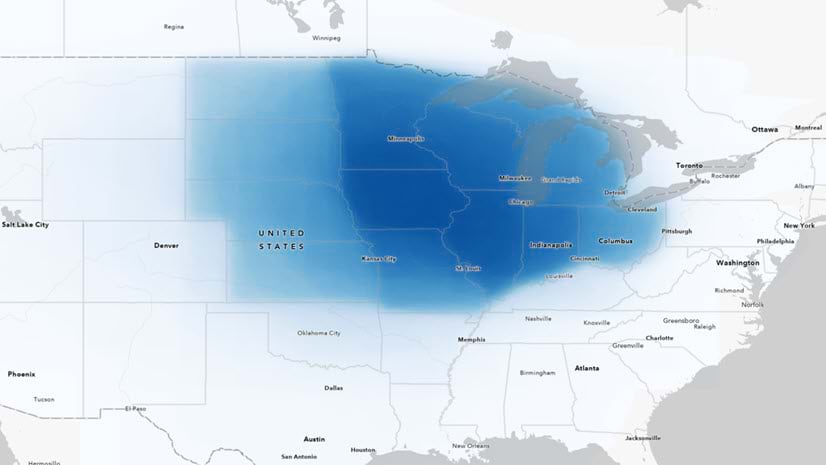
New for this event we put together a Trends map based on the Ushahidi feed set up by the ABC. We’ve been working more closely with Ushahidi these days – some of you may have seen our press release last October announcing our Strategic Partnership. Unlike pure social media, where the percentage actionable and geo-located information can be quite low, a high percentage of the Ushahidi reports contain actual latitude longitude values that pinpoint the reported incident to an exact location. The communities that post to Ushahidi during a crisis are dedicated and as a result the quantity of information coming from the feed can be overwhelming when consumed as individual incidents. One way to pull meaningful information out of the feed is to visualize the data as a hot spot map instead of the individual points. This gives you a better sense of where the concentration of reports that are coming from. You can click on the different categories on the left hand side to show only those categories as hot spots on the map. Furthermore you can filter the data by time by clicking on the link on the bottom left and adjusting the time slider accordingly. If you want to just see the concentrations of points as dots uncheck the “Show Reports” box.
While this hot spot function is a visualization technique in the web tier, we can also bring in the data from Ushahidi to ArcGIS Desktop via a custom tool. One of the tech wizards in our group quickly developed an ArcGIS 10 Desktop add-in that connects to the Ushahidi feed and stores it locally in the geodatabase for further analysis. This provides Ushahidi as a data source for further analytics using traditional GIS tools and operations like Kernel Density, Frequency, and Geostatistics. You can download the Ushahidi add-in for ArcGIS Desktop here.
We have also dispatched our wildfire specialist Tom Patterson to Australia to assist (see the video). He brings along many years of experience mapping operationally on incidents and more recent lessons learned from the Gulf Oil Spill and also Mobile Mapping for First Responders.
While the impact of these floods are tragic, we stand by in admiration of the resolve of the Australian people and are ready and willing to do what we can to help expedite the recovery.