By Kenneth Field, Esri Research Cartographer
![]()
1. Introduction
In part 1 and part 2 of this blog entry, you learned about some of the design considerations for creating a large-scale 3D map, prepared your 2D building data in ArcMap, used ArcScene to create 3D representations of your building data, and transferred your data to Google SketchUp to render your models and then brought your models back into ArcScene. In this final part, you will use the models to create a 3D isometric map and add a range of additional symbols to create a rich large-scale 3D landscape for your static map.
2. Defining an Isometric Map Projection in ArcScene
Figure 1 illustrates the finished model of the university campus in ArcScene viewed with the default perspective projection. With the perspective projection, the foreground buildings appear much larger than those in the background. By placing a regularly spaced grid underneath the model, you can see how the perspective projection modifies scale and angles across the image.

Figure 1. University Model in ArcScene with Perspective Projection
To modify the projection properties, you need to alter the ArcScene View Settings (View > View Settings). There are a number of controls you can modify in View Settings to change the viewing angle relative to the point of observation. To create an isometric map, you need to modify the projection properties, though you’ll notice there is no option to directly change from perspective to isometric (figure 2). You can, however, achieve the isometric effect by first changing the viewfield angle to 1 (the minimum), and, second, increasing the pitch angle. A pitch angle of 38 degrees seems to work well, though you can experiment with this setting to create a viewing pitch suited to your intended map product.

Figure 2. Modifying View Settings to Create an Isometric Projection
Figure 3 shows you the change in the way the university campus now appears. Changing the pitch angle has the effect of raising the viewer’s position in the scene relative to the central part of the scene. Changing the viewfield angle displays the scene with a narrow field of view applied equally across the entire image. The regular grid now clearly demonstrates the equal scale and angles across the image that the isometric projection creates.

Figure 3. University Model in ArcScene with Isometric Projection
3. Adding Map Detail
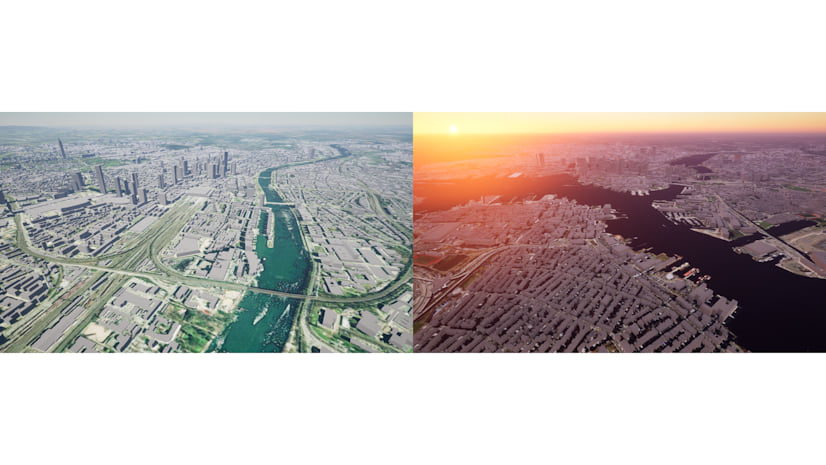
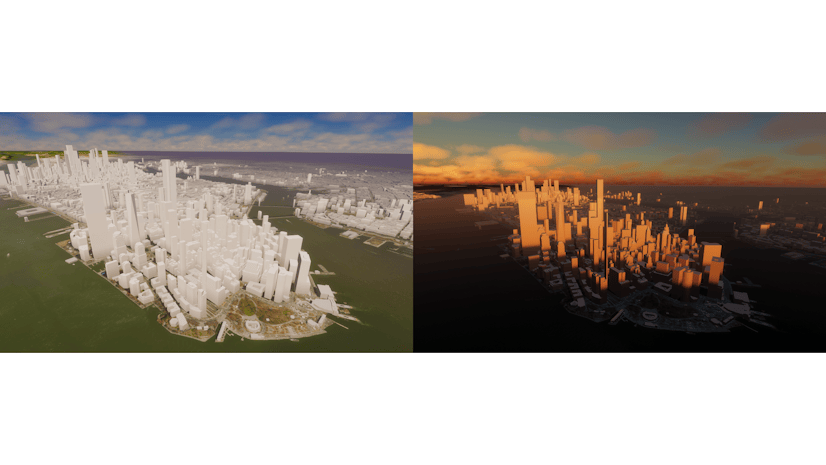
Now that you have the 3D model as an isometric projection in ArcScene, you can use it as a basis for preparing the final map product. Recalling that it is detail that adds clarity to the Paris and Manhattan examples you saw in part 1 of this blog entry, there are a number of ways you can add to your map.
Adding some large-scale basemap detail into the map places your model in its real-world location. You might have large-scale detail already, or you might have created it specifically for your project by doing a local survey. For the university campus, large-scale data exists for the surrounding area that includes local roads, sidewalks, parking lots, and footprints of other buildings. By adding it as a layer in ArcScene and symbolizing the 2D data in harmony with the colours used in your model, you can create a well-designed basemap for your model to sit on. Figure 4 shows the use of subtle, complementary colours that illustrate the street layout and also shows where other buildings exist. Because they are not part of the university campus, they are not included as models, but symbolizing them as footprints creates a good visual hierarchy between the surrounding basemap and the university itself.

Figure 4. Adding Basemap Detail to Place the Model in Its Surrounding Context
As part of the local survey undertaken by the university, the locations of street furniture (signposts, benches, etc.), walls, and vegetation were collected. These were stored as point feature classes in a file geodatabase with details of each feature’s height and rotation (from north) also collected and added as attributes. The point feature classes were added to ArcScene as a new layer. Symbolizing these point features is the same as in ArcMap, except you now have the option of using 3D marker symbols. The ArcGIS Resource Center contains details of how to symbolize a point as a 3D marker using a style. A range of signposts, barriers, bins, bollards, benches, and streetlights were used from ArcGIS 3D marker styles and the height and rotation of each symbol set in the layer’s Symbology > Advanced properties (figure 5).

Figure 5. Symbolizing Point Features Using 3D Marker Symbols
Adding street furniture and vegetation begins to bring the detail of the university campus to life (figure 6).

Figure 6. Adding street furniture and vegetation increases the detail
Trees and shrubs are stored as point features in a separate feature class and symbolized using the same technique as the other point features. Tree species and height in the layer’s attributes are used to create symbols that match 3D marker symbol names and scale the 3D marker symbols correctly. Using the Advanced button, rotation is set to random so that the 3D trees appear more natural (figure 7).

Figure 7. Symbolizing Vegetation Using Random Rotation for the 3D Marker Symbols
Figure 6 also shows the addition of walls, fences, and raised planters, which are 2D polygon features extruded in the layer properties by their height attribute in the same way as you originally extruded the building footprints in part 1 of the blog entry.
An alternative to symbolizing vegetation using 3D markers is to use COLLADA models and edit the tree feature class, replacing the trees with trees modeled outside ArcGIS. There are numerous online libraries of COLLADA models available that could be used for this (though it is important to check the End User License Agreements of such library services to ensure there is no restriction on using the models in a different mapping or geographic application or service). To take this approach, you will first need to turn your tree feature class into a multipatch feature class (as you did for the building models in part 1 of the blog entry). Then you will follow the same 3D editing process to select a feature and replace it with a COLLADA model that was illustrated in part 2 of this blog entry (for the building models). Figures 8a–c illustrate the process.

Figure 8a. A Selection of Trees on the University Campus Symbolized Using ArcGIS 3D Marker Symbols

Figure 8b. Selecting a Tree and Replacing It with a Model

Figure 8c. ArcGIS 3D Marker Tree Replaced by a Third-Party COLLADA Model
4. Adding Map Symbols
The university model is going to be used as a map for people to navigate around the campus. The detailed isometric map built thus far shows the campus environment in detail. To make the map more useful, though, you can add further symbols and text using the 3D Graphics toolbar (figure 9). Begin by adding a new graphics layer to ArcScene and, if necessary, add further layers within the Graphics layer to organize your symbology. For the university map, building labels, symbols, cars, and plants and street labels were added.

Figure 9. The 3D Graphics Toolbar in ArcScene
Using the various tools on the 3D Graphics toolbar, you can add 3D marker, line, and polygon symbols and 3D text. All your new graphics will be digitized and stored in the graphics layer that you target. The following ArcGIS Resource Center topics explain in detail how to digitize graphics features in ArcScene:
Digitizing a 3D point in ArcScene
Digitizing a 3D line graphic in ArcScene
Digitizing a 3D polygon graphic in ArcScene
Digitizing a 3D text graphic in ArcScene
Figure 10 illustrates the map in ArcScene with the addition of a range of graphics.

Figure 10. University Campus Model in ArcScene with the Addition of Graphics Layers
5. Finishing the Map
Since the purpose of this model is to create a static 3D isometric map of the university campus, the final stage is exporting it from ArcScene. Select File > Export Scene > 2D and choose an appropriate file format. PNG generally works well. This will create an image of the scene from ArcScene. You can then import this into a graphics package or back into an ArcMap layout for finishing.
Figure 11 shows the final map as an ArcMap layout. The PNG was added using Insert > Picture and the title and legend detail added using the Drawing tools in ArcMap.

Figure 11. Final University Campus Map
6. Using the 3D Model in Alternative Ways
The model created for the university campus map can be used in alternative ways. For instance, by rotating the model in ArcScene, you can create exported PNG files from different viewing positions. This might be useful for creating You Are Here-style maps where the map is displayed with the buildings in front of the viewer rather than having them interpret their location and orientation in a single map from a fixed position. Figure 12 illustrates the same model, rotated to show the university campus from an alternative viewing position. Note how the graphic symbols have automatically rotated with the view so they are correctly aligned.

Figure 12. Using the Model to Create Alternative Viewing Positions
Using ArcScene functions for animation and the Animation Toolbar, the 3D model can provide a great basis from which to create a short movie. The University Introduction movie (figure 13) was created by exporting an animation from ArcScene and then using Microsoft Windows Live Movie Maker to add simple transitions, text, graphical effects, and a soundtrack. You can view the entire movie by clicking on the image below (133Mb).
Figure 13. Still from the Kingston University Movie
7. Summary
This three-part blog has shown you how to take 2D data for a large-scale area and use it as a basis for creating a detailed 3D model. It has shown you the various processes for transferring your data between software packages and also the file formats you need to work with. It has also shown you how to create highly detailed and rich symbology and finish the map in an isometric projection to replicate the approach taken by the Bretez-Turgot Plan de Paris and Constantine Anderson’s Midtown Manhattan maps.
It’s at this point that acknowledgment should be made to the final group of students I taught at Kingston University before joining Esri. This project was set as an assignment in response to the publication of newly commissioned official university maps which, in truth, were extremely poor so we set about developing alternatives. The students applied their GIS and cartographic knowledge and skills to develop a range of superior products. They were rewarded at the 2011 Esri International User Conference with first place in the multimedia map category in the User Applications Fair. It also formed the basis for the work I presented in the Making Beautiful Maps session at the User Conference. Their great work underpins this blog entry.
Thanks to my former students Alex Chiu, Alistair Leak, Becky Watson, Chris Clarke, Harry Tull, Max Canty, Nick Bosch, Sam Jackson, and Tapiwa Sithole. Great work…and still so much better than the university’s official maps!


Looks like links to part 1 and part 2 are broken.